Meknes Travel Guide
Getting there
By Plane
The nearest airport is in Fes, around 64 kms away.
By Train
Meknes is accessible from most major cities in Morocco. Journey times: Fes - 40 minutes, Rabat - 2 hours 15 minutes, Casablanca - 3 hours 30minutes, Marrakech - 6 hours 30 minutes and Tanger - 3 hours 30 minutes.
By Bus
The CTM bus station is near Meknes train station. Choose to travel with CTM instead of the older but cheaper buses you can find in the main bus station (west of the medina).
By Car
Meknes is connected via the A2 highway, to Fes, Rabat, Casablanca and Marrakesh.
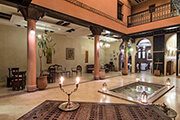
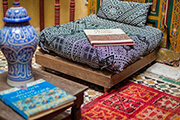
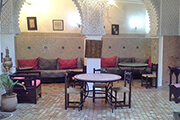
Where to Stay in Meknes
History
The city was founded in the 9th century by the Meknassa tribe who had fled Kairouan in Tunisia. The Almohades destroyed the city to build a larger and more imposing city, between 1199 and 1213.
After the Almohads the Merinids built some Madrassas like Bou Anania in 1331 as well as also some mosques and Kasbah.
The Alawite Sultan Moulay Ismail began the construction of a great palaces, gardens, monumental gates and over 40 kilometers of walls 15 meters height.
He used at least 25,000 European slaves for the construction, kidnapped from European villages by Moroccan pirates. In 1696 the Sultan ordered the demolition of the El Badia Palace in Marrakesh to reuse materials in Meknes. The sultan chose Meknes as capital of his empire in 1672.
Places to visit
Meknes Medina
This medina is smaller than the one in Fes but it is cleaner and will charm you with its authentic atmosphere, many shops and great choice of restaurants.
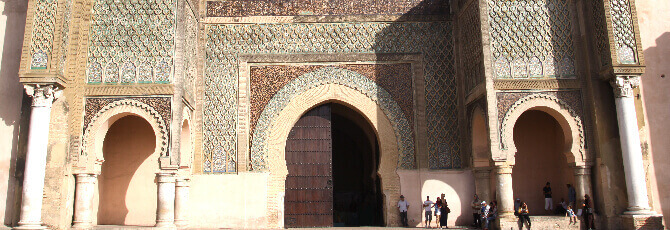
Bab Mansour Gate
This amazing gate was completed 5 years after Moulay Ismail's death, during the reign of his son Moulay Abdellah in 1732. This is the main entrance of the Imperial Palace built for Moulay Ismail. The gate was named after the architect, El-Mansour, a Christian renegade who converted to Islam.
The marble columns that decorate the side bastions were taken from the Roman ruins of Volubilis.
Agdal basin
The Agdal basin is located 500m south of the Mechouar and the Royal Palace Mhensha. It is a large water storage tank located inside the Kasbah. It was built under the reign of Sultan Moulay Ismail in the early eighteenth century to serve as a strategic reserve of water and to irrigate the gardens and orchards in the city.
The basin has a trapezoidal plan and measures 319m long and 149m wide, with a depth that varies between 2m and 3.5m.
Hri Souani
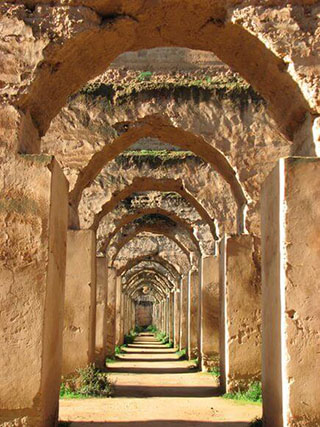
Located some 500 meters south of the Royal Palace this monument dates back to Moulay Ismail in the early eighteenth century.
This is one of the prestigious historic monuments in Meknes. It groups a series of relatively cramped rooms around a spacious central hall of 26m long, 10m wide and 9m high. It was a place for food storage. It contains 10 rooms with ten well waterwheels. Water from these wells was used both for the building and for the basin.
Hri Souani was also the place where grain and hay were stored to feed Moulay Ismail's 12,000 horses.
Mausoleum of Moulay Ismail
The mosque was built in 1703 by the Sultan Ahmed Eddahbi and became the mausoleum where Sultan Moulay Ismail (1645-1727) was buried along with one of his wives and two of his sons. This is one of the few religious buildings in Morocco open to non-Muslims.
The burial chamber is richly decorated and you can see the four Comtois clocks which were a gift from the King of France, Louis XIV, to the Sultan. Louis XIV wanted to be forgiven after refusing to give his daughters in marriage to Moulay Ismail.
Bou Anania Madrasa
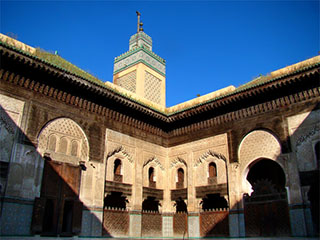
The madrassa was builded by Abu'l-Hassan and completed by his son and successor Abou Inan in 1345. It is an elegant rectangular building. The prayer room borders the courtyard to the east. The front door is adorned with a splendid decoration with zelliges and carved plaster.
The mihrab (which indicates the direction of Mecca for prayers), whose ornamentation is still preserved is remarkable for the epigraphic decoration. The pillars are decorated with zelliges, inscriptions and enriched with plaster panels.
Bab al Khmis
Originally Bab el Khmis was the western part of 'Madinat al-Riad al Anbari' (City of the Amber garden), a sumptuous city built under the reign of Moulay Ismail in favor of his Oudatas army and for important people. His successor Moulay Abdellah destroyed this part of the building in 1731.
Bab Berdaine
The gate is in the extreme north of the ancient city and stands on top of a hill. Its exterior is in the same style as the monumental gates of Meknes. Its decorated part is very similar to that of Bab Khemis.
Qara Prison
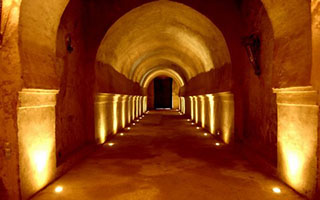
Qara was a Portuguese architect and prisoner and this ancient prison is located inside the Ismaili Qasba, near the Ambassador's lodge. The monument was built in the early eighteenth century. It is a vast underground area consisting of three rooms composed of a series of arches resting on pillars with an average size of 140cm by 3 m 46cm, and supporting barrel vault loaders.
Museums
Dar Jamaï
Built during the time of Sultan Moulay El Hassan I in 1882, it was the residence of his Vizier, Abou Abdellah El Jamaï. This building was converted into a museum in 1958. Originally it included a bath, a slaughterhouse, shops and a fondouk (place or store of goods, animal housing and a place to accommodate merchants and travelers).
Currently, there is only the noble part and annexed housing remaining. The building is characterized by an Andalusian type garden (Riad) with pathways of zellige, fruit trees and flowers.
Near Meknes
Volubilis
The Mauritanian capital, founded in the 3rd century B.C., became a Roman city and quickly grew, exceeding an area of 40 hectares. The historical site is located 40 minutes by car, 31km north of Meknes.
Moulay Driss Zerhoun
Just 4km from Volubilis, Moulay Driss Zerhoun is a small town over two hills at the base of Mount Zerhoun. In 789, it was here that Moulah Idriss I arrived, bringing with him the religion of Islam. He is also buried in the town.
The quietest and most underrated of Morocco’s four imperial cities, Meknes was the 17th-century capital of Sultan Moulay Ismail, who left it monumental gates, walls and granaries. It makes a calm base and pairs perfectly with Roman Volubilis. Here is what to do.
Top Things to Do in Meknes
- Stand before Bab Mansour. The grandest ceremonial gate in Morocco, framed by huge zellij-tiled columns, facing the main square El Hedim. The symbol of Meknes.
- Visit the Mausoleum of Moulay Ismail. The richly decorated resting place of the sultan who made Meknes his capital — one of the few religious monuments in Morocco open to non-Muslims.
- Explore Heri es-Souani. The immense royal granaries and stables built to feed and hold thousands of horses, with cavernous vaulted halls and an adjoining reservoir (Agdal basin).
- Soak up Place El Hedim. The lively main square in front of Bab Mansour, a smaller and more relaxed cousin of Marrakesh’s Jemaa el-Fna, ringed with cafes.
- Wander the Medina. A UNESCO-listed old town that is easy and unhurried to explore, with a covered market and craft souks and far fewer crowds than Fes.
- See the Dar Jamai Museum. A 19th-century palace with a beautiful Andalusian garden, housing a collection of Moroccan crafts and traditional arts.
- Step into a Medersa. The Bou Inania Medersa, a finely decorated 14th-century Quranic school, showcases classic Merinid craftsmanship in carved wood and stucco.
How Many Days in Meknes?
Meknes itself is a half-day to full-day city. The classic plan is to base here or in Fes and combine Meknes with a morning at Volubilis, the best Roman site in Morocco, just up the road.
Getting There and Around
Meknes sits on the main train line, about 40 minutes from Fes and a few hours from Rabat and Casablanca. Grand taxis run to Volubilis and Moulay Idriss. See our map of Meknes.
Because it is so close to Fes, many travelers day-trip to Meknes; staying overnight, though, lets you enjoy Place El Hedim in the evening without the crowds.
Frequently Asked Questions
Is Meknes worth visiting?
Yes. Meknes offers imperial monuments like Bab Mansour, the Mausoleum of Moulay Ismail and the Heri es-Souani granaries with far fewer crowds than Fes or Marrakesh, and it is the gateway to Roman Volubilis.
How many days do you need in Meknes?
Half a day to a full day covers the city. Combining it with Volubilis and Moulay Idriss makes a rewarding full day.
Is Meknes better than Fes?
Fes has the larger and more famous medina, while Meknes is quieter, more monumental and easier to navigate. They are only 40 minutes apart, so many travelers see both.
How far is Volubilis from Meknes?
The Roman ruins of Volubilis are about 30 kilometres from Meknes, roughly a 40-minute drive, and are usually visited together with the town of Moulay Idriss.
Share your experiences with our community.
Join our Mailing List and receive electronic invitations and news about cultural events in Morocco.
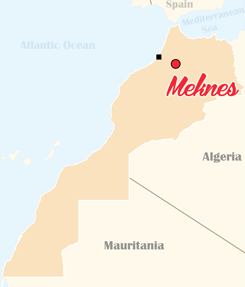 Coordinates: 33° 53′ 42″ N, 5° 33′ 17″ W
| Name in English | Meknes |
| Name in Arabic | Maknas |
| Region | Fes - Meknes |
| Population | 632 079 |
| Demonym | Meknassi |
| Zip Code | 50 000 |
- Meknes weather
- Tuesday 12:00
- Overcast clouds
-
 22ºC | 71°F
- More details about Meknes Weather
Advertisement
Advertisement