Moroccan Music
From the Amazigh Dynasty going back more than a thousand years, up to its restoration as sovereign nation from the French protectorate, Morocco is an exotic country filled with culture and tradition, and music is at the heart of this nation's cultural heritage.
Music is fundamental in the Moroccan daily life. It brings rhythm to almost all events, happy or unhappy, since the dawn of times. Many musical styles coexist, played on a relatively limited number of instruments.
Instruments of Moroccan Music
Include the rebab, a bowed string instrument, that looks like a little primitive violin from which the medieval European rebec is derived; the violin, borrowed from the West, is played while resting on the thigh, almost like the viola de gamba; the nay, flute made of reed; the lute, called the “ud” in Arabic; the tambourine and the derbouka, made of skin stretched on a pottery, that we hold under the arm...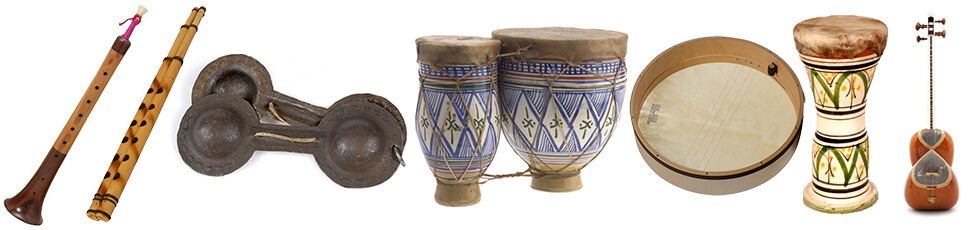 From Left to Right : Ghaita - Mijwiz - Qarqaba - Tam-Tam - Bendir - Tarija - Tar
Ghaita
A Moroccan folk shawm or oboe played at weddings and other ceremonies, also used for recreational music for dancing.
Mijwiz
A double-flute with two similarly-pitched sides and notched reeds for mouthpieces.
Qarqaba
A pair of two-sided hand cymbals, clapped together to make interlocking rhythm patterns.
Moroccan Tam-Tam
A double drum made from ceramic bowls covered with goatskin. One side is larger than the other, resulting in two different pitches.
Bendir
A circular instrument with goatskin on one side and strings running along the back of the drum head, mostly used in traditional Moroccan weddings.
Tarija
A small ceramic hourglass-shaped drum with snares on the inside, sometimes played with one hand snapping a finger onto the drum head for a popping sound.
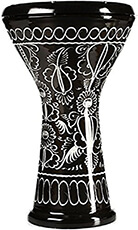
Derbouka
This instrument looks like tarija but it is bigger, it is also used in the Middle East, it is placed under the arm or resting on the player's leg.
Buy this Moroccan Derbouka :
Tar
A small frame drum with jingles attached to the rim–like a tambourine.
Oud
This beautiful music instrument is a cousin of the lute, it is mostly used in Moroccan Andalusian Music.
Listen to this awesome music :
Popular Instruments
Amongst the popular instruments, we can find: the sintir, long lute with two or three strings that sounds a bit muffled; the ghayta, some kind of oboe played by the snake charmers on the Jamâa El-Fna square in Marrakesh; the tebilats, little twin drums made of terracotta or earthenware, covered by skin, and sold everywhere in the souk; the taarija, a small version of the derbouka, used a lot on the day of Ashoura, the children's festival; the bendir, a large tambourine with a wooden frame on which a goat skin stretches, is the favorite instrument of the Berber Awash...
On to the music itself, four genres can be distinguished:
The Andalusian Music
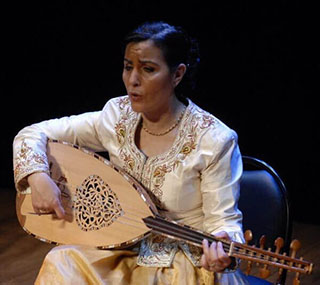
The Andalusian music, skillful, is played in unison. Its melody features remind people of the music at the time of medieval Christendom (Gregorian chants). It has been introduced in Morocco during the 12th century, when the Muslims were chased away from Granada and settled in Tétouan, that became the home of Andalusian music in Morocco. This music style brings together singers and instrumentalists. The orchestra is composed of a rebab, a tar (tambourine), a derbouka and a laud which is a kind of four-string mandolin. The singers sing poems in classical Arabic or in Andalusian. Nowadays, this classical music, particularly popular amongst intellectuals, is still very present in the conservative societies of big cities.
Popular Music
Popular music is much more common. It is frequently accompanied, though a skillful rhythmic counterpoint, by the singers' hand clapping as well as the audience's, to whom these Arab melodies are addressed. The melodies are lighter and the lyrics are inspired from old tales or forgotten legends told by the hayada, singer of rural festivals. The songs, which are extremely long, are also played in unison, most of the time in “griha”, which means that they are improvised. In Marrakech, popular music takes the form of the “aïta”, which means “the call”: the improvisation is made from the strident shouts of the singers and the repetitive sound of the tambourines. Another popular music instance is the “n'fir”, used during parades or religious feasts. The n'fir sounds like parade music and military marching.
Berber Music
Berber music consists of highly repetitive chants that are partially improvised. It is inseparable from the dance and is conceived as a true show. Each tribe possesses its own customs and its own style which are expressed mainly during the big collective feasts of Ahidou and Ahouache. The dancers, accompanying themselves with a bendir, are also the singers and the musicians.
Raï
Raï, the last embodiment of the popular music, of Algerian origin, and which combines Arab-African rhythms and a mix of traditional and modern instruments (electric guitars, synthesizer), is becoming more and more successful in Morocco. In France, one of the most famous performer is the singer Khaled, who was in Marrakesh in 1997, since he couldn't get closer to his roots in Algeria.
Paul Bowles and Morocco
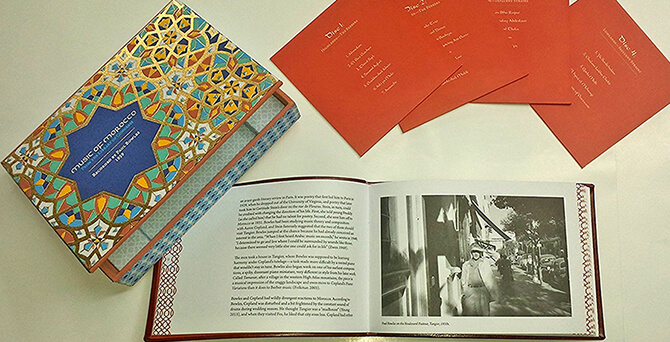
Paul Bowles is an American traveler, a composer and a writer. He spent most of his life in Morocco and is known for his recording of Moroccan music, if you're interested in Moroccan Music you can enjoy this fantastic recording made in 1959.
The Main Styles of Moroccan Music at a Glance
| Style | What it is |
|---|---|
| Andalusi | Refined classical suites inherited from Al-Andalus, played by orchestras in Fes, Tetouan and Rabat |
| Chaabi | The popular music of weddings and celebrations - the sound you will hear everywhere |
| Gnaoua | Spiritual trance music with guembri and qraqeb, celebrated at the Essaouira festival |
| Amazigh (Ahidous, Ahwash) | Collective village music and dance of the Atlas - drums, call-and-response and circle dances |
| Malhoun | Urban sung poetry in Moroccan Arabic |
| Rai and fusion | Modern sounds from the north-east, plus a lively fusion and hip-hop scene in Casablanca |
Hear It Live: Festivals and Places
The best introductions are the Gnaoua World Music Festival in Essaouira (June), Mawazine in Rabat, the Fes Festival of World Sacred Music, and simply an evening on Jemaa el-Fna in Marrakesh, where Gnaoua and Chaabi groups play until late.
Frequently Asked Questions
What is traditional Moroccan music called?
There is no single style: Morocco's main traditions are Andalusi (classical orchestral music from Al-Andalus), Chaabi (popular festive music), Gnaoua (spiritual trance music of Sub-Saharan origin), Amazigh (Berber) village music like Ahidous and Ahwash, and Malhoun (sung poetry).
What is Gnaoua music?
Gnaoua is the spiritual, hypnotic music brought to Morocco by descendants of Sub-Saharan communities, played with the guembri lute, metal qraqeb castanets and call-and-response singing. The Gnaoua World Music Festival in Essaouira celebrates it every June.
Where can I hear live music in Morocco?
Jemaa el-Fna square in Marrakesh has musicians every evening; Essaouira hosts the Gnaoua Festival in June; Rabat's Mawazine is one of the largest festivals in the world; and Fes hosts the Festival of World Sacred Music.
Related articles : Culture
 Zellige Tilework
 Traditional Clothing
 The Moroccan Caftan
 Moroccan Weddings
 Moroccan Proverbs and Quotes
Join our Mailing List and receive electronic invitations and news about cultural events in Morocco.
Advertisement